

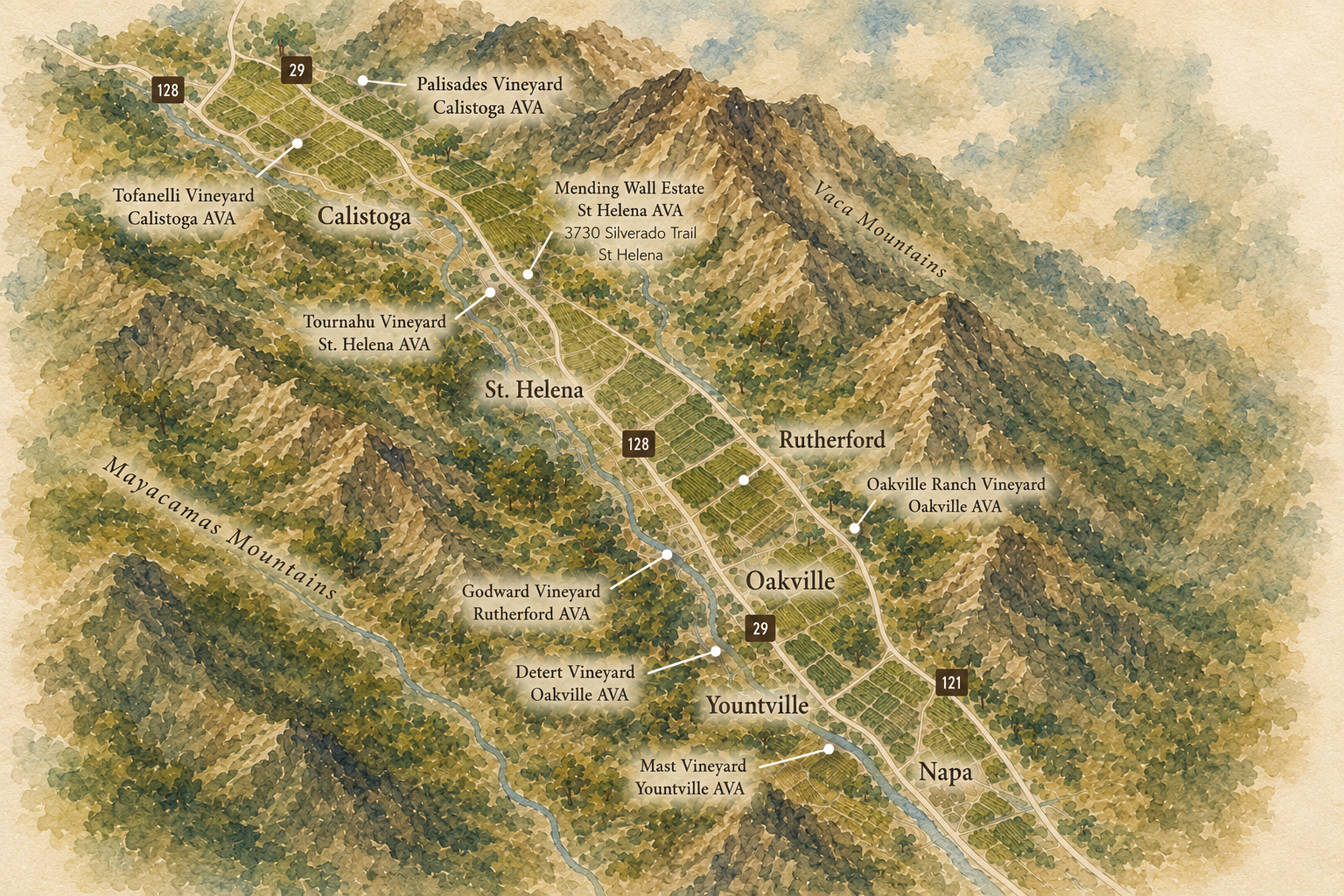
Palisades Vineyard — Calistoga AVA
Hidden away in its own secluded canyon at the foot of the Palisades Mountains, this historic vineyard has been growing Petite Sirah since 1974, planted with guidance from Napa legend Vincent Arroyo. The head-trained, heritage-style vines, some more than fifty years old, grow at the foot of the Palisades: a band of volcanic bedrock thrust upward nearly three million years ago as part of the Vaca Range. Below the alluvial soil balances rocky, gravelly drainage with mineral-rich structure, stressing the vines just enough to concentrate flavor in the fruit. Though tucked into one of the warmest corners of Napa Valley, the vineyard catches cooling ocean air through the Chalk Hill Gap, and the resulting diurnal swing helps the grapes hold onto bright, balancing acidity. The result is Petite Sirah with deep, structured character and a real sense of place.
Tofanelli Vineyard — Calistoga AVA
Sitting at the base of Diamond Mountain, Tofanelli Vineyard is one of Napa Valley's last true old-world sites, family-owned and farmed since the 1920s and one of the few pre-WWII vineyard properties still in continuous operation in the valley. Organic farming and head-trained vines have been the norm here long before either was in fashion. The vines are dry-farmed, their deep root systems drawing water and nutrients from far below the surface rather than relying on the vineyard floor. This resilience facilitates early ripening, and is one of one of the first vineyards harvested each year. Plantings include Sauvignon Blanc, Semillon, Charbono, and Zinfandel, a heritage mix reflecting how the valley was farmed generations ago.
Mending Wall Estate — St. Helena AVA
The heart of winery operations for winemaker Thomas Rivers Brown, the Mending Wall estate spans 20 acres in the far northeast corner of St. Helena, just south of the Calistoga appellation line. Once home to old-vine Syrah, the estate has since given way to a small planting of Cabernet Sauvignon and Sauvignon Blanc, grown in nutrient-rich soils that yield a consistent annual crop. The vineyard sits where the warmth of the mid-valley is balanced by the cooling afternoon breezes that come through the Chalk Hill Gap. Beyond its role in the vineyard portfolio, this property serves as the home of hospitality and tastings for Mending Wall, where guests can experience the estate firsthand alongside the winery's single-vineyard wines from across the valley.
Tournahu Vineyard — St. Helena AVA
Located at the narrowest point of the valley floor between Howell and Spring Mountain, the Tournahu Vineyard sits on an old riverbed with topography that's unusual for the Napa Valley floor. Soil surveys have identified five distinct soil series, a blend of loam and clay laced with river cobble stones ranging from golf-ball to softball size. This diversity, paired with good drainage, produces wines of unusual complexity and nuance for a valley-floor site. The vines are trained on a unilateral cordon system and planted entirely to Cabernet Sauvignon Clone 7, a selection prized for its structure and depth. The result is a wine of power and precision, drawing complexity from one of St. Helena's most geologically distinctive sites.
Godward Vineyard — Rutherford AVA
Located along the western Rutherford Bench, Godward Vineyard sits between two of Napa's most storied neighbors, Staglin and Scarecrow. Its modern iteration was planted in 2002 by Gary Morisoli, one of Rutherford's master farmers. This vineyard boasts classic Rutherford soil at work: alluvial clay and loam prized for dense, richly structured Cabernet Sauvignon, giving rise to "Rutherford dust," the fine, dusty tannin that's become the AVA's calling card. The vineyard's modest seven acres are trained on a modified sprawl trellis, an old-school, low-intervention method that shades the fruit through the long, warm season. Year after year, Godward delivers pure Cabernet Sauvignon class: density, structure, and minerality that captures Rutherford at its best.
Oakville Ranch Vineyard — Oakville AVA
While most of the Oakville AVA sits on the valley floor, Oakville Ranch climbs the eastern hills to elevations between 880 and 1,000 feet, immediately below Pritchard Hill, making it the highest vineyard elevation in the appellation. The sprawling estate is farmed by pioneering organic farmer Phil Couturri. The old vines, grown on St. George rootstock, are trained on a VSB trellis system and rooted in iron-rich, red volcanic soil, a challenging environment that gives the fruit its signature mountain character. Drip irrigation and the site's naturally rocky, low-nutrient terrain keep the vines under constant, gentle stress, producing small berries with a high skin-to-juice ratio. It's this very struggle, met with careful farming, that gives Oakville Ranch fruit its intense power, concentration, and truly unique character.
Detert Vineyard — Oakville AVA
Few vineyards in Napa carry the pedigree of Detert. Originally part of the historic To Kalon estate, first purchased by H.W. Crabb in 1891, the vineyard sits on some of the finest soil in western Oakville. Its 7-acre "East Block," planted in 1949, is widely regarded as Napa Valley's first Cabernet Franc planting. The Detert family purchased the land in 1954 and has farmed it with meticulous care ever since. These old vines grow in gravelly, well-drained alluvial loam, struggling to produce small, intensely concentrated berries where site, soil, climate, and a touch of ineffable magic converge to create greatness. Today, Detert remains one of Oakville's most storied addresses, tucked between neighbors like the Mondavi Monastery Block and Harlan Estate, a rare, irreplaceable piece of the valley's history.
Mast Vineyard — Yountville AVA
Mast is the southernmost vineyard from which Mending Wall sources fruit, sitting on the eastern Yountville bench where the benchland soils that run through Oakville extend south into their coolest expression. The block of Cabernet Sauvignon here is composed of gravelly silt loams mixed with alluvial soils and rock, well-drained ground that gives the vines just enough to work for. Winds from the San Pablo bay cool the vineyard each evening, tempering the valley's warmth and preserving the fruit's natural acidity. The result in the glass is Cabernet Sauvignon defined by vitality and freshness, elegant rather than powerful. Farmed by the Bettinelli family, every step throughout the growing season here is deliberate, and Mending Wall is thrilled to work with such exceptional farming partners.
Hidden away in its own secluded canyon at the foot of the Palisades Mountains, this historic vineyard has been growing Petite Sirah since 1974, planted with guidance from Napa legend Vincent Arroyo. The head-trained, heritage-style vines, some more than fifty years old, grow at the foot of the Palisades: a band of volcanic bedrock thrust upward nearly three million years ago as part of the Vaca Range. Below the alluvial soil balances rocky, gravelly drainage with mineral-rich structure, stressing the vines just enough to concentrate flavor in the fruit. Though tucked into one of the warmest corners of Napa Valley, the vineyard catches cooling ocean air through the Chalk Hill Gap, and the resulting diurnal swing helps the grapes hold onto bright, balancing acidity. The result is Petite Sirah with deep, structured character and a real sense of place.
Sitting at the base of Diamond Mountain, Tofanelli Vineyard is one of Napa Valley’s last true old-world sites, family-owned and farmed since the 1920s and one of the few pre-WWII vineyard properties still in continuous operation in the valley. Organic farming and head-trained vines have been the norm here long before either was in fashion. The vines are dry-farmed, their deep root systems drawing water and nutrients from far below the surface rather than relying on the vineyard floor. This resilience facilitates early ripening, and is one of one of the first vineyards harvested each year. Plantings include Sauvignon Blanc, Semillon, Charbono, and Zinfandel, a heritage mix reflecting how the valley was farmed generations ago.
Located at the narrowest point of the valley floor between Howell and Spring Mountain, the Tournahu Vineyard sits on an old riverbed with topography that’s unusual for the Napa Valley floor. Soil surveys have identified five distinct soil series, a blend of loams and clay laced with river cobble ranging from golf-ball to softball size. This diversity, paired with good drainage, produces wines of unusual complexity and nuance for a valley-floor site. The vines are trained on a unilateral cordon system and planted entirely to Cabernet Sauvignon Clone 7, a selection prized for its structure and depth. The result is a wine of power and precision, drawing complexity from one of St. Helena’s most geologically distinctive sites.
The heart of winery operations for winemaker Thomas Rivers Brown, the Mending Wall estate spans 20 acres in the far northeast corner of St. Helena, just south of the Calistoga appellation line. Once home to old-vine Syrah, the estate has since given way to a small planting of Cabernet Sauvignon and Sauvignon Blanc, grown in nutrient-rich soils that yield a consistent annual crop. The vineyard sits where the warmth of the mid-valley is balanced by the cooling afternoon breezes that come through the Chalk Hill Gap. Beyond its role in the vineyard portfolio, this property serves as the home of hospitality and tastings for Mending Wall, where guests can experience the estate firsthand alongside the winery’s single-vineyard wines from across the valley.
Located along the western Rutherford Bench, Godward Vineyard sits between two of Napa’s most storied neighbors, Staglin and Scarecrow. Its modern iteration was planted in 2002 by Gary Morisoli, one of Rutherford’s master farmers. This vineyard boasts classic Rutherford soil at work: alluvial clay and loam prized for dense, richly structured Cabernet Sauvignon, giving rise to “Rutherford dust,” the fine, dusty tannin that’s become the AVA’s calling card. The vineyard’s modest seven acres are trained on a modified sprawl trellis, an old-school, low-intervention method that shades the fruit through the long, warm season. Year after year, Godward delivers pure Cabernet Sauvignon class: density, structure, and minerality that captures Rutherford at its best.
While most of the Oakville AVA sits on the valley floor, Oakville Ranch climbs the eastern hills to elevations between 880 and 1,000 feet, immediately below Pritchard Hill, making it the highest vineyard elevation in the appellation. The sprawling estate is farmed by pioneering organic farmer Phil Couturri. The old vines, grown on St. George rootstock, are trained on a VSB trellis system and rooted in iron-rich, red volcanic soil, a challenging environment that gives the fruit its signature mountain character. Drip irrigation and the site’s naturally rocky, low-nutrient terrain keep the vines under constant, gentle stress, producing small berries with a high skin-to-juice ratio. It’s this very struggle, met with careful farming, that gives Oakville Ranch fruit its intense power, concentration, and truly unique character.
Few vineyards in Napa carry the pedigree of Detert. Originally part of the historic To Kalon estate, first purchased by H.W. Crabb in 1891, the vineyard sits on some of the finest soil in western Oakville. Its 7-acre “East Block,” planted in 1949, is widely regarded as Napa Valley’s first Cabernet Franc planting. The Detert family purchased the land in 1954 and has farmed it with meticulous care ever since. These old vines grow in gravelly, well-drained alluvial loam, struggling to produce small, intensely concentrated berries where site, soil, climate, and a touch of ineffable magic converge to create greatness. Today, Detert remains one of Oakville’s most storied addresses, tucked between neighbors like the Mondavi Monastery Block and Harlan Estate, a rare, irreplaceable piece of the valley’s history.
Mast is the southernmost vineyard from which Mending Wall sources fruit, sitting on the eastern Yountville bench where the benchland soils that run through Oakville extend south into their coolest expression. The block of Cabernet Sauvignon here is composed of gravelly silt loams mixed with alluvial soils and rock, well-drained ground that gives the vines just enough to work for. Winds from the San Pablo bay cool the vineyard each evening, tempering the valley’s warmth and preserving the fruit’s natural acidity. The result in the glass is Cabernet Sauvignon defined by vitality and freshness, elegant rather than powerful. Farmed by the Bettinelli family, every step throughout the growing season here is deliberate, and Mending Wall is thrilled to work with such exceptional farming partners.